+200 VISUAL CARDS FOR UK ELECTRICIANS
BS 7671 clearly explained, visual and straight to the point
BS 7671 18th Edition – for apprentices, exams and on-site work, all at a glance. Safe isolation, earthing and bonding, circuit design, special locations, inspection and testing, and fault finding in visual cards: one topic per page, already updated with Amendment 4.
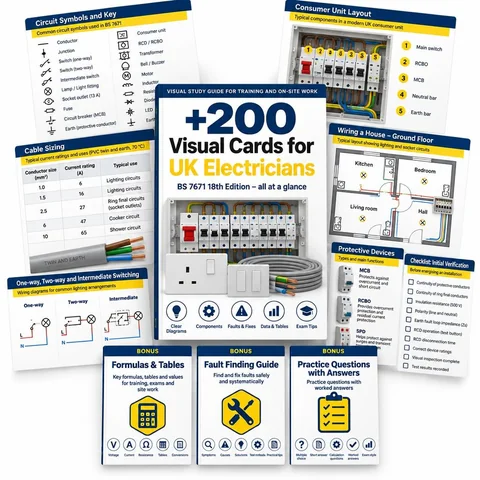
Reading the regulations is one thing. Looking at a consumer unit and really understanding the earth fault loop path, when an RCD should trip and why the cable size depends on the installation method is something else. These cards show you the symbol, the component and the connection in a drawing instead of long paragraphs. Instead of 500 pages of text: the essentials at a glance.
Instant access after purchase, on mobile, tablet or computer.
Some of the visual cards waiting for you inside
💡 Tip: Tap and hold (or hover) any card below to pause and inspect the diagram
Organised by topic, including:
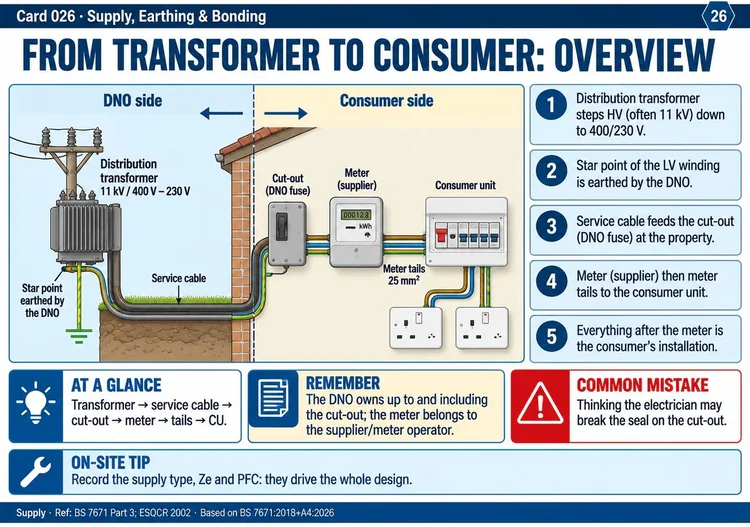
From transformer to consumer
The whole supply chain on one page: distribution transformer, service cable, cut-out, meter and tails to the consumer unit, and who owns each part.
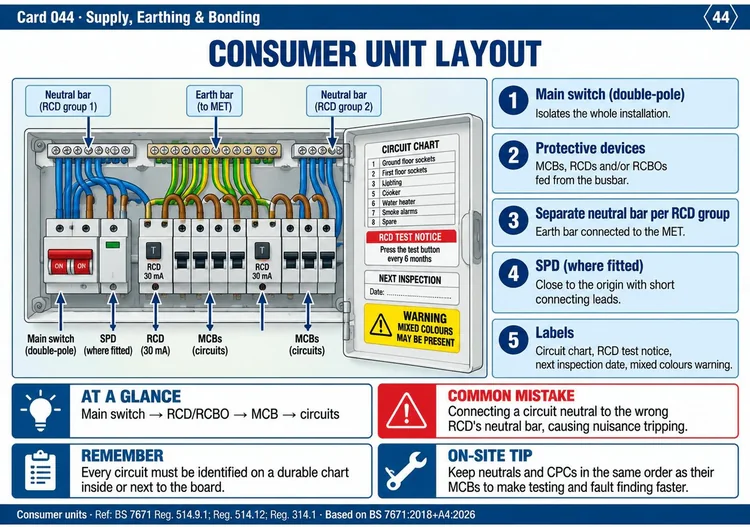
Consumer unit layout
Main switch, RCBOs and RCDs, MCBs, SPD, neutral and earth bars: where each part sits in the board and what the labels must show.
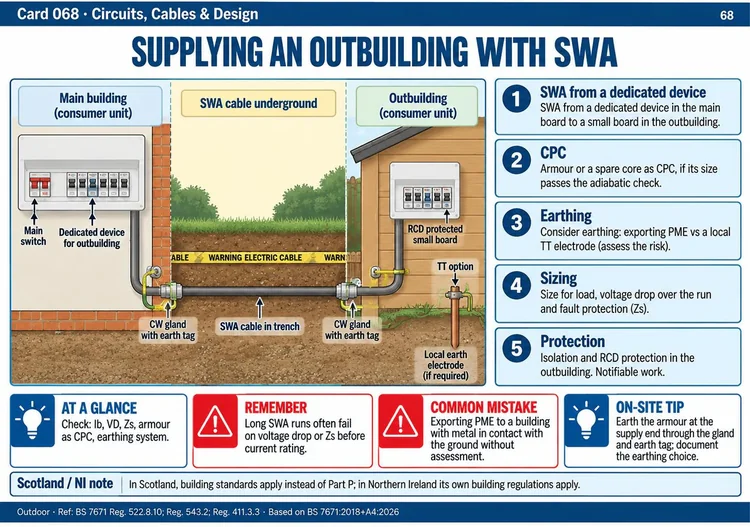
Supplying an outbuilding with SWA
Dedicated device in the main board, SWA run, glands and earthing at the outbuilding, and the PME question answered in one drawing.
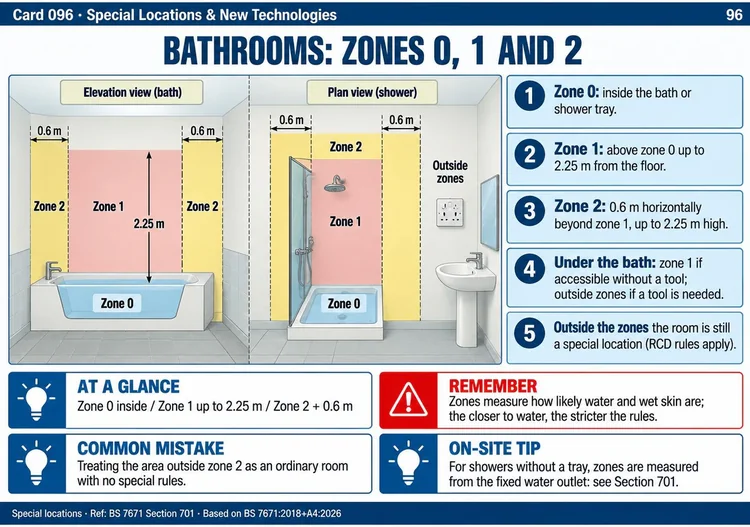
Bathrooms: zones 0, 1 and 2
What can go in each zone, the measurements that define them and the IP rating each one needs.
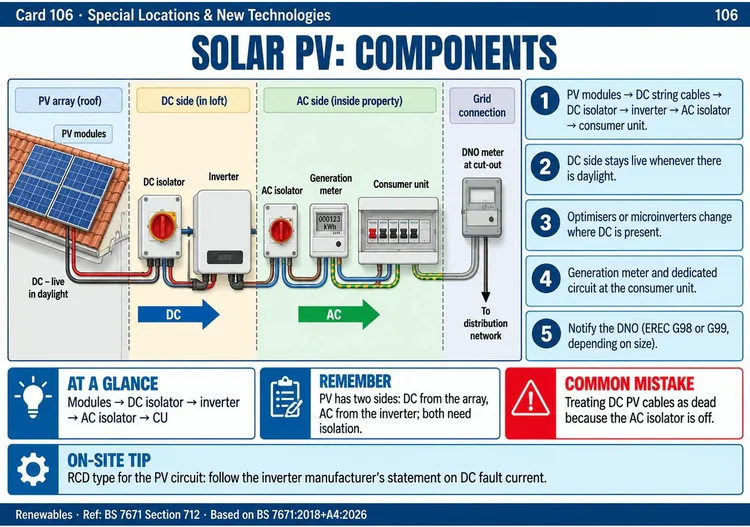
Solar PV: components
From modules to the consumer unit: DC side, isolators, inverter, generation meter and the AC connection, with the DNO notification.
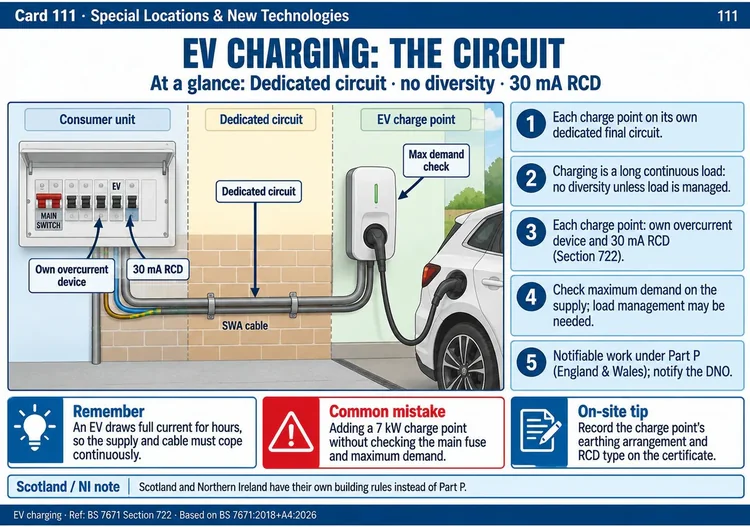
EV charging: the circuit
Dedicated circuit, no diversity, 30 mA RCD protection, earthing arrangement and maximum demand for a charge point.
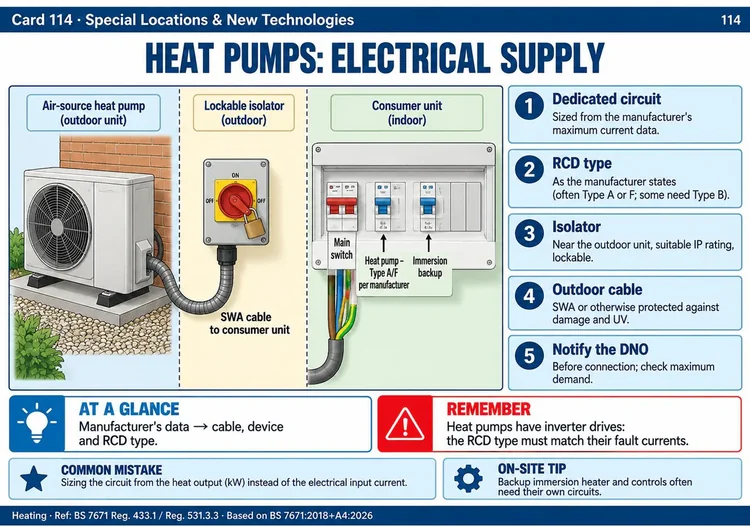
Heat pumps: electrical supply
Dedicated circuit, isolator, RCD type and outdoor cable for a heat pump, plus the notification to the DNO.
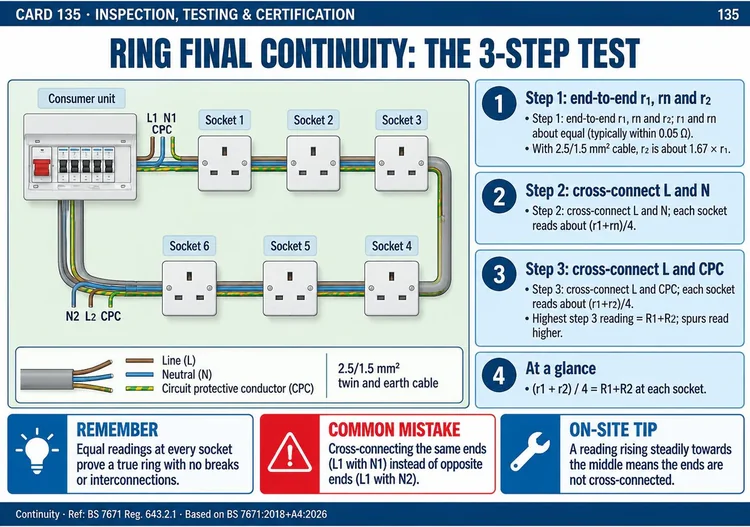
Ring final continuity: the 3-step test
End-to-end readings, cross-connecting L and N, then L and CPC: the sequence and the readings you should expect at every socket.
What's inside
Safety & the Regulations
Safe isolation step by step, GS38 test equipment, the Electricity at Work Regulations 1989, how BS 7671 is laid out and how to read a regulation number, plus Part P and what is notifiable.
Supply, Earthing & Bonding
TN-S, TN-C-S (PME) and TT, the main earthing terminal, protective bonding sizes, Ze and PFC, disconnection times and where 30 mA RCD protection is required.
Circuits, Cables & Design
Ring finals and radials, lighting from one-way to intermediate switching, cable types, Ib ≤ In ≤ Iz, correction factors, voltage drop, max Zs, the adiabatic equation and safe zones in walls.
Special Locations & New Technologies
Bathroom zones, outdoor circuits and outbuildings, pools and saunas, solar PV, battery storage, EV charging and heat pumps, already updated with Amendment 4.
Inspection, Testing & Certification
The correct test sequence, R1+R2, ring continuity, insulation resistance, polarity, Ze, Zs and RCD tests, plus the EIC, Minor Works and the EICR with codes C1, C2, C3 and FI.
On-site Practice & Fault Finding
Reading diagrams, terminations and torque, three-phase basics, first and second fix, and how to trace an RCD that trips, low insulation, a broken ring or a dead socket.
Understand it, don't just memorise it.
BS 7671 made visual, practical and clear at a glance.
The regulations are dense, your notes are spread across college, course materials and site, and Amendment 4 has changed things again. Here each card stands on its own: you open the one you need, look at the drawing and carry on, at college, before the exam or on site. On your mobile, on the computer or printed out in a folder.
GET INSTANT ACCESS →💡 Tip: Tap and hold (or hover) any card below to pause and inspect the diagram
Who this material is for
You're an apprentice
On a Level 2 or Level 3 electrical installation course. The content is all there, but spread across course materials, college and your own notes. Here every topic has its own card, with a drawing and an example.
Your exam is coming up
18th Edition or Inspection & Testing: you revise faster, topic by topic, with the regulation number and a common mistake on every card, instead of fighting your way through hundreds of pages of regulations.
You're qualified and need to be up to date
You know the trade. You want an organised reference for cable sizing, voltage drop, Zs and testing, already updated with Amendment 4.
You're changing career
On a domestic installer course or retraining as an electrician: alongside your training, the cards give you the trade topic by topic, from safe isolation to testing.
You train or teach
One card per topic explains faster than twenty slides: put the drawing up on the wall and the point lands.
You learn with your eyes
Drawing, table and example on the same page, instead of paragraphs you have to read three times.
What you get
+200 Visual Cards for UK Electricians
- +200 visual cards for UK electricians, ready to look up
- Safety & the Regulations: safe isolation, GS38, Part P
- Supply, Earthing & Bonding: TN-S, TN-C-S, TT, bonding, RCDs
- Circuits, Cables & Design: rings, radials, cable sizing, voltage drop
- Special Locations & New Technologies: bathrooms, solar PV, batteries, EV
- Inspection, Testing & Certification: test sequence, EIC, EICR codes
- On-site Practice & Fault Finding: three-phase, first and second fix, fault tracing
- Based on BS 7671:2018+A4:2026, with Scotland / NI notes where the rules differ
- One topic per page, with regulation number, common mistake and on-site tip
- 100% digital: mobile, tablet, computer or printed out
And that's not all…
Alongside the cards, you get three bonuses for study, exams and on-site work.
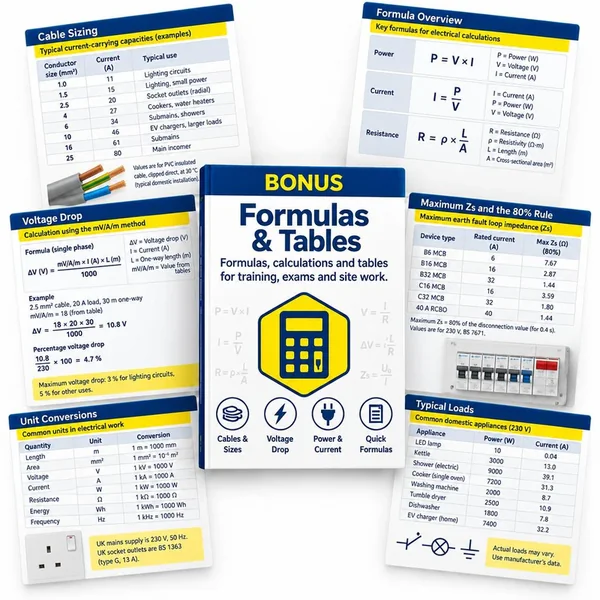
Formulas & Tables for UK Electricians
Ohm's law and power, single-phase and three-phase, voltage drop in mV/A/m, max Zs and the 80% rule, the adiabatic equation, correction factors and conversions, with worked examples.
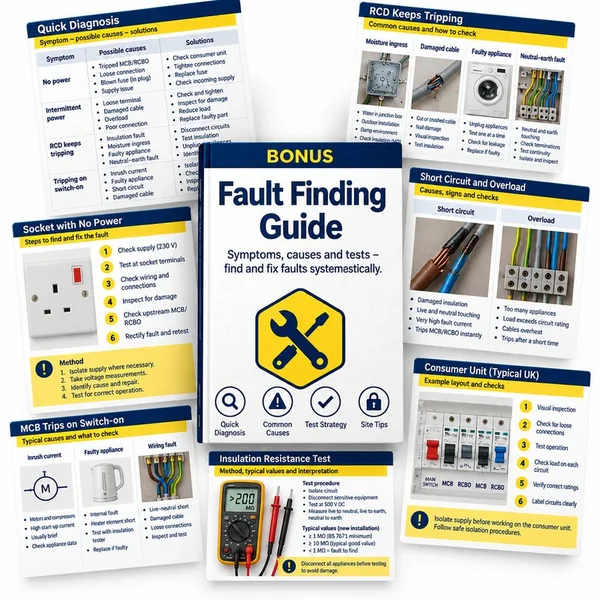
Fault Finding & Troubleshooting Guide
Work methodically instead of guessing: around 24 cases set out as symptom → likely cause → test → fix, such as an RCD that keeps tripping, low insulation resistance, a dead socket and a broken ring.
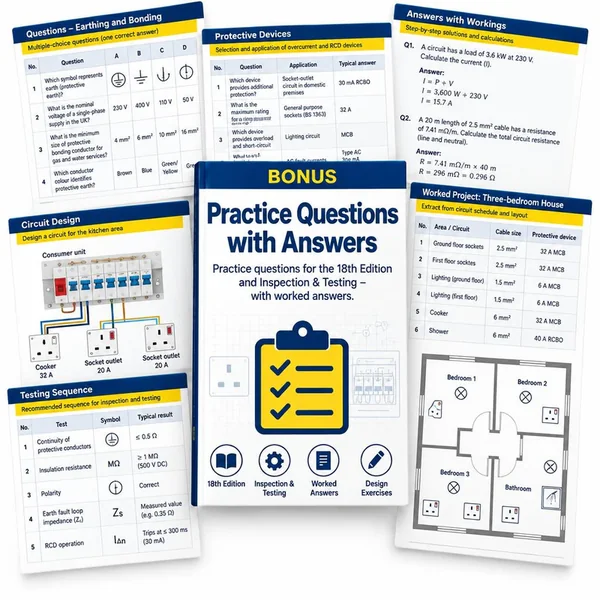
Practice Questions with Answers
150 of our own practice questions in the style of the 18th Edition and Inspection & Testing exams, plus 2 worked design exercises, with an explanation for every answer.
EVERYTHING YOU GET: +200 VISUAL CARDS + 3 BONUSES
One payment, everything included:
INTRODUCTORY OFFER
COMPLETE ACCESS
+200 Visual Cards for UK Electricians
All the cards from the six sections plus the three bonuses, for college, exam preparation and on-site work.
- +200 Visual Cards for UK Electricians in six sections
- Safety & the Regulations, Supply, Earthing & Bonding
- Circuits, Cables & Design
- Special Locations & New Technologies
- Inspection, Testing & Certification
- On-site Practice & Fault Finding
- Based on BS 7671:2018+A4:2026, with Scotland / NI notes
- Bonus 1: Formulas & Tables for UK Electricians
- Bonus 2: Fault Finding & Troubleshooting Guide
- Bonus 3: Practice Questions with Answers
- Digital access: mobile, tablet and computer
- Permanent access to the cards and the three bonuses
- Future updates included
Instead of £47, only:
£19
One-off payment · Instant access
Card, Apple Pay, Google Pay and PayPal • 100% secure payment
“Once you see the drawing, you understand the circuit – not just the one in your notes.”

15-DAY MONEY-BACK GUARANTEE
You have 15 days to look through all the cards and the three bonuses at your own pace.
If the format isn't right for you, just send us a short email.
You get 100% of your money back, no forms and no questions asked.
✔ No forms ✔ No questions asked ✔ Full refund
How access works
Open, look up and revise as often as you like.
Complete your order
You complete your order in a secure checkout, with the payment method of your choice.
Get your access
As soon as your payment is confirmed, your members' area is unlocked automatically and your login details arrive by email.
- Available immediately
- Personal members' area
- For computer, tablet and mobile
Open the four items
- 📘 +200 Visual Cards for UK Electricians
- 📐 Formulas & Tables for UK Electricians
- 🔧 Fault Finding & Troubleshooting Guide
- 📋 Practice Questions with Answers
Look it up when it matters
A question about a ring final circuit or a cable size? You open the card on that topic, check it and carry on where you left off.
Frequently asked questions
1. What is +200 Visual Cards for UK Electricians?
Digital study material made up of visual cards on UK electrical installation work. Each card covers one topic on one page: a technical drawing or diagram, the key points, the regulation number, a “Common mistake” box and an “On-site tip”. From safety, earthing and bonding through circuit design and special locations to inspection, testing and fault finding.
2. Who is it for?
For Level 2 and Level 3 apprentices, for adults retraining as electricians, for example on a domestic installer course, and for qualified electricians who need to get up to date or are preparing for the 18th Edition or Inspection & Testing exams. It is not a DIY guide: electrical work must only be carried out by competent persons.
3. Is it up to date with Amendment 4?
Yes. The cards are based on BS 7671:2018+A4:2026, the 18th Edition with Amendment 4, including what changed for batteries, solar and EV charging. Values on the cards are for guidance: always check the current edition and the manufacturer’s instructions.
4. Will it help me with the 18th Edition or Inspection & Testing exam?
It helps you prepare with confidence: you revise faster, topic by topic, see common mistakes at a glance and practise with 150 of our own questions in the style of both exams, each with an explanation. The studying is still down to you, but you go into the exam better organised.
5. Does it cover Scotland and Northern Ireland?
Yes. The cards are based on BS 7671, which is used across the UK. Where Scotland or Northern Ireland differ, for example on building regulations and notification, the card carries its own “Scotland / NI note”.
6. How do I get access?
As soon as your payment is confirmed, your access is unlocked automatically and your login details arrive by email. Nothing is posted: the material is 100% digital, and your access does not expire.
7. Can I use it on my mobile?
Yes. The cards open on mobile, tablet and computer, so you have them with you at college or on site.
8. Can I print the cards?
Yes. Print the cards you use most and keep them in your college folder or in your tool bag.
9. Do I need any prior knowledge?
It helps, but it isn’t required. The cards start with safety, how the regulations are laid out and the basics, and explain each topic with a drawing and an example, without assuming you already know the jargon.
10. How does the 15-day guarantee work?
You have 15 days to look through everything: the cards and the three bonuses. If the format isn’t right for you, send us a short email and you get a full refund, no forms and no questions asked.